
Linky AI is one of the biggest AI character chat apps on either store, and the honest review answer is: capable app, unusually messy paperwork. I have not paid for a Linky account yet, so this review comes from a different kind of work: I read its terms, both store listings, its privacy policy, the Australian eSafety Commissioner’s guide, and two years of user threads, and I wrote down what actually holds up.
Key takeaways from the documents:
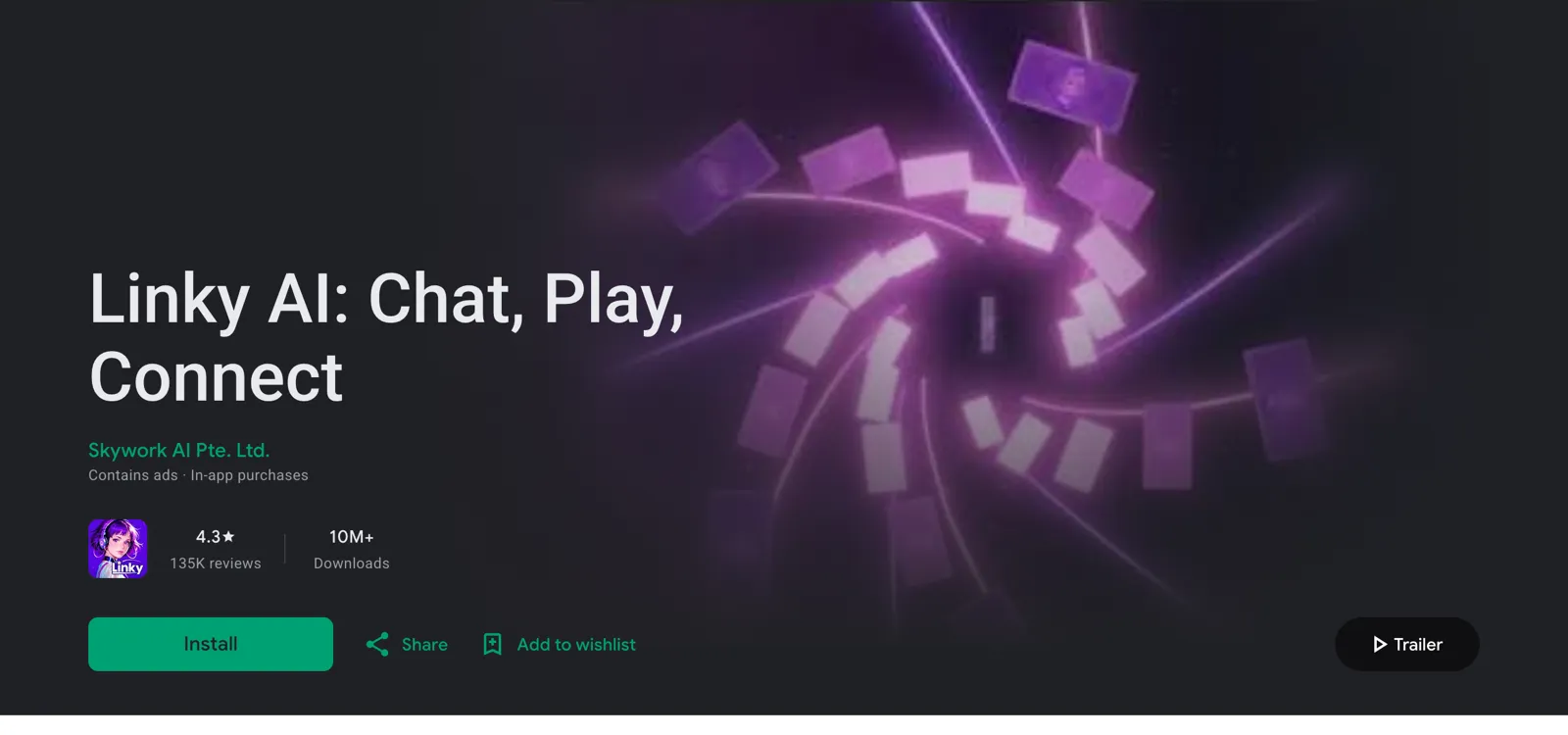
- Scale is real. 10M+ Android downloads, 4.3 stars from 135K Play reviews, 4.4 from 7.7K on Apple, and an update shipped July 28, 2026. This is not an abandoned app.
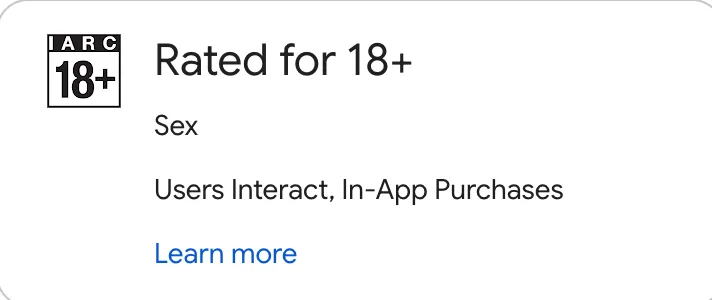
- Both stores rate it 18+, with Apple’s descriptors including Sexual Content or Nudity and Loot Boxes.
- Its own documents disagree about who may use it: 16, 17, and 18 appear as minimum ages in three different official texts.
- Pricing is coins plus two subscriptions: Linky Pro at $9.99 and Linky Gold at $17.99, with coin packs from $0.99 to $99.99.
- The company name depends on where you look: Skywork AI Pte. Ltd. on Google Play and in the terms, SKY INTERACTIVE TECHNOLOGIES PTE. LTD. on the Apple listing.
What is Linky AI?
Linky AI is an AI character chat app by Singapore-based Skywork AI that lets you talk to a large catalog of AI characters, build your own with custom looks and personalities, and play collection mechanics like character cards on top of the conversations. The Play listing opens by calling it a “Top1 AI chat bot”; the eSafety Commissioner describes it more plainly as an AI chatbot where you chat with pre-made characters, create your own, and play games including cards that reveal a character’s secrets.
The feature set, from the official descriptions: text chat with contextual memory, AI voice calls, character creation, story-style roleplay, and search filters that include romance, spicy, fantasy, adventure and LGBT. Multi-language support covers English, German, Indonesian and others. The anime-leaning catalog and the card mechanics explain who this app actually attracts, and that audience question is exactly where the paperwork starts to matter.
Is Linky AI safe?
The short answer: the app is 18+ by both stores’ ratings, its data label discloses third-party sharing, and its own legal documents cannot agree on a minimum age. Nothing in the record shows a breach or a scam, but “safe” here depends on which document you choose to believe, so I pulled the three that conflict.
Three minimum ages in its own paperwork
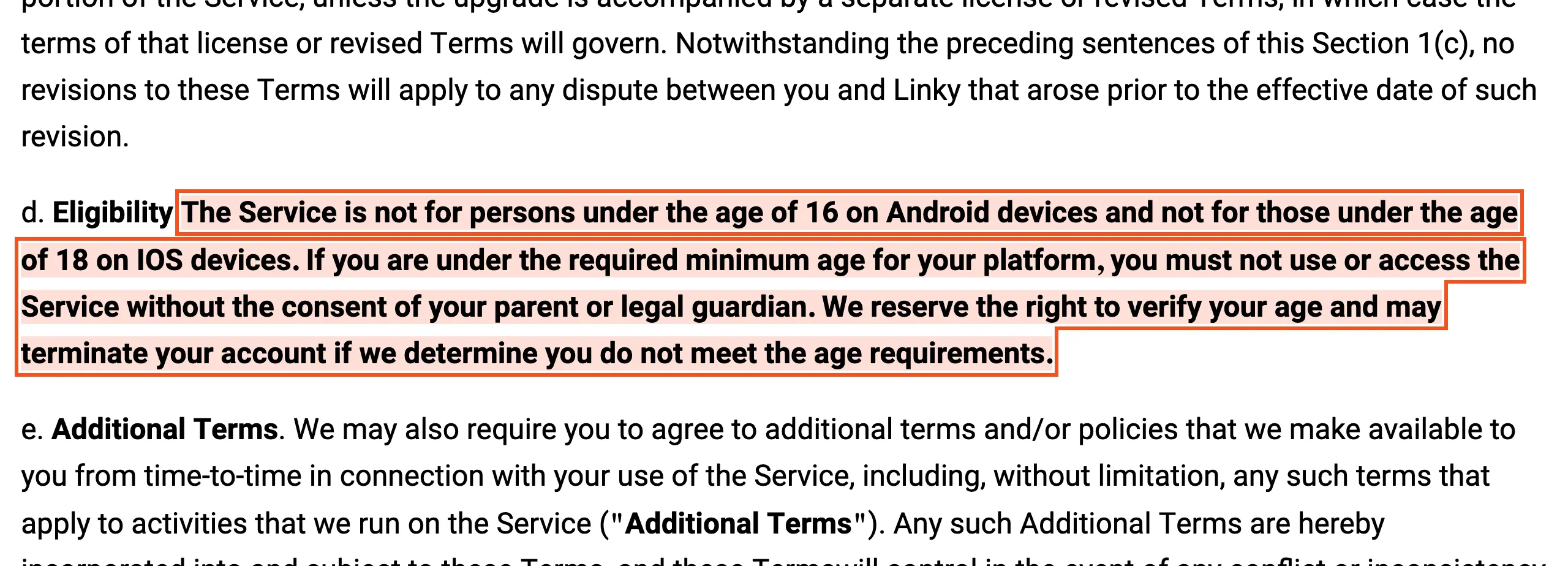
I read both copies of Linky’s terms, and they contradict each other. The terms served at m.linke.ai say, verbatim: “The Service is not for persons under the age of 16 on Android devices and not for those under the age of 18 on IOS devices.”
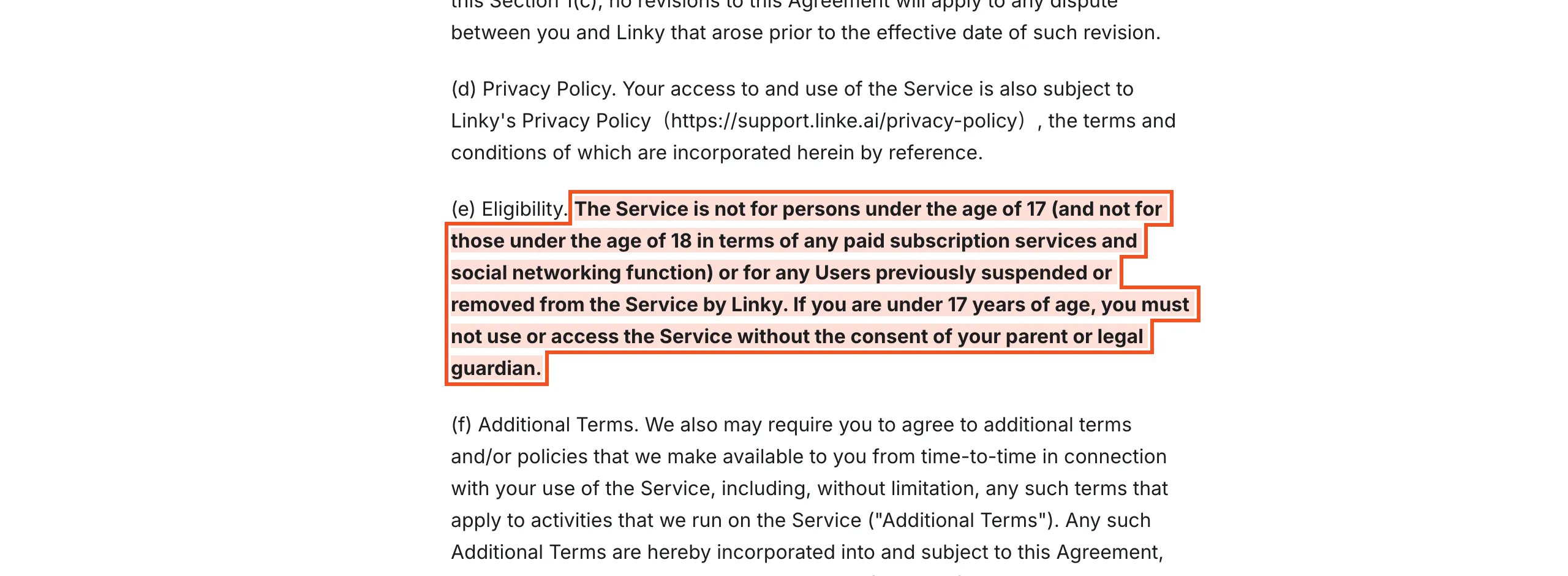
The copy at support.linke.ai says instead: “The Service is not for persons under the age of 17 (and not for those under the age of 18 in terms of any paid subscription services and social networking function)”. The privacy policy backs the 17 line and promises account termination for younger users. That is three different floors, 16, 17 and 18, across documents that are all currently live, while both app stores rate the product 18+.
A clause that cannot decide its own number reads to me like paperwork nobody maintains, and it matters beyond pedantry: age policy is the exact place where an 18+ character app with a young-skewing anime catalog needs to be precise.
Data safety: what the store labels disclose
The Play data-safety label states the app may share app activity and device or other IDs with third parties, and may collect personal info and app activity among others. Data is encrypted in transit, and you can request deletion. That is a fairly standard profile for a free app with ads, which Linky is on the free tier; it is not a privacy-first profile, and the privacy questions in this article’s FAQ inherit that answer.
What the eSafety Commissioner records
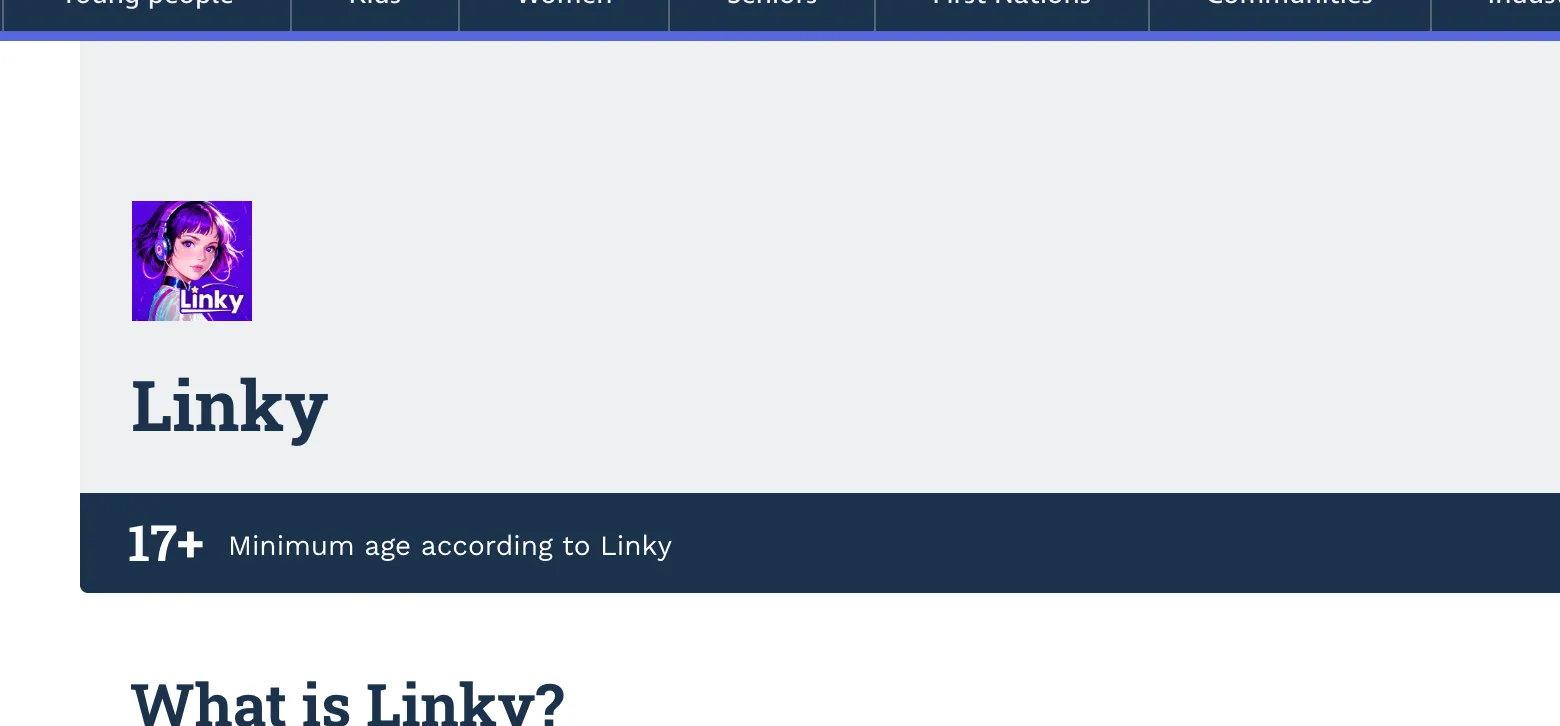
The strongest authority that has actually reviewed Linky is the Australian eSafety Commissioner, whose guide records a “17+ Minimum age according to Linky” banner, notes that there is sexually explicit content in character descriptions and in the company’s social media accounts, and flags the terms’ position that Linky is under no obligation to remove content. A government safety guide is not a review, but it is the one source in this SERP that read the same documents I did and put a number on the record.
Pricing: what free actually gets you
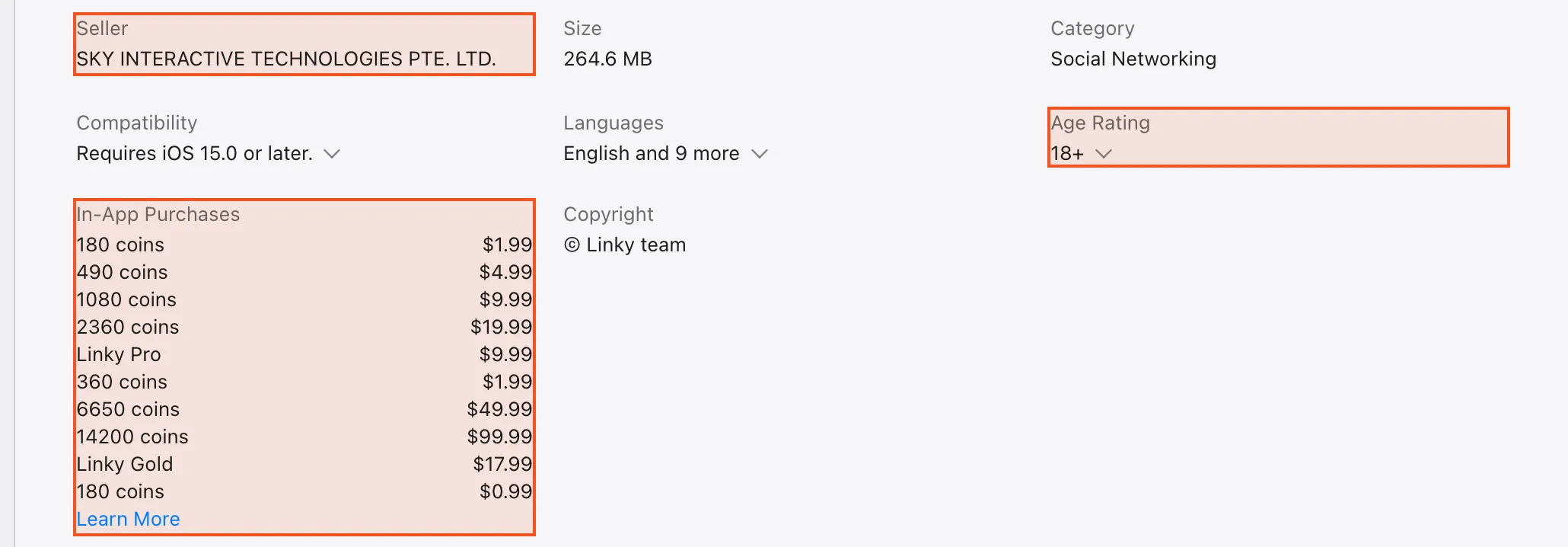
Linky AI is free to install with ads, and the free tier’s real function, judging by the AI Overview consensus and two years of user threads, is to walk you to the paywall. Users describe it as thin; Google’s own synthesized verdict cites the “restrictive free tier” and “heavy reliance on premium subscriptions.” What the paid layer costs is published on the Apple listing’s in-app purchase list, so this table is store data, not marketing copy:
| What you buy | Price (Apple list, Aug 2, 2026) |
|---|---|
| Coin packs (180 to 14,200 coins) | $0.99 to $99.99 |
| Linky Pro (subscription) | $9.99 |
| Linky Gold (subscription) | $17.99 |
What Pro and Gold actually include is not itemized anywhere official that I could find, which is its own finding: two subscription tiers priced at store level with no published benefit sheet. One more data point from the community record, labeled as a single user report: a Reddit user described buying Pro, having the app crash, and never receiving the features. I cannot verify one anecdote, but “what exactly did I just buy” is a fair question to ask before $17.99 a month, and the official answer is currently a shrug.
Are there real people on the other end?
Nothing official says so: the stores sell Linky as AI characters, full stop. The suspicion comes from the community, and it is persistent enough that Google now autocompletes the question. In the longest-running thread about the app, one user flatly claims the chats are staffed (“It is people in a call center… pretending to be a computer generated AI”), and another describes leaving after the app “added those ‘real ladies who want money’”, which reads like a paid live-chat feature layered onto the AI catalog.
I found no evidence that the AI characters are humans, and the call-center theory is unverified. What the User-Generated Content and Users Interact flags on both store listings do confirm is that Linky carries human-to-human surfaces alongside the AI. So the precise answer is: the characters are sold as AI, some monetized human layer has been reported by users, and Linky publishes nothing that draws the line clearly. An app in this category earns trust by drawing exactly that line.
What happened to the app in 2024 and 2025
“What happened to Linky AI” is a real search with a real story behind it. Assembled from the community record and the current listings, dated where the sources allow:
- 2024: filter tightening. Users describe NSFW chat being allowed while images were not, then both being blocked. The eSafety guide still documents explicit content in character descriptions, so the tightening was about generation, not the catalog surface.
- 2024 to 2025: the App Store gap. Multiple users report Linky being pulled from Apple’s store (“They got banned by Apple because they used to have NSFW content”), with a period when installed copies kept working but no listing existed. The eSafety guide links only an Android app to this day.
- 2025: the glitch window. Threads describe the app going unavailable while chats degenerated into repeated Chinese text and stray German, which reads like a serious backend incident nobody ever explained.
- 2026: both stores, active development. Version 3.31.0 on Apple, an update on Google Play dated July 28, 2026, and 10M+ installs. Whatever happened, the app came back and is being maintained.
The pattern worth noting is not any single incident; it is that every explanation in that timeline comes from users, not from the company. Linky has no public status page, no changelog I could locate, and no statement on the removal.
Verdict: who it fits, who should skip it
One honest limit first: the thing this review cannot tell you is what the content filter actually does mid-conversation today, because that only shows up inside a hands-on test paid for with my own money, and that is how I normally work. On the documents and the record, this is where I land.
Linky fits someone who wants a big, actively-developed anime character catalog with voice and collection mechanics, accepts an 18+ app with ads and coins, and is comfortable treating the free tier as a demo. The scale, the ratings, and the July 2026 update are real signals; tens of millions of people use this thing without incident.
Skip it, or at least keep your card in your pocket, if any of the paperwork above bothers you: subscription tiers with no published benefit list, legal documents that disagree about their own age floor by two years, a company that answers removals and glitch windows with silence, and an unexplained human layer inside an AI product. None of that is a scam signal; all of it is a maintenance signal, and with companion apps I have learned that the paperwork usually tells you how the product will treat you later.
If what you actually want is an AI companion where the pricing and the filter have been tested against reality with real money, the two closest tested picks on this site are below; for the anime-catalog itch specifically, my AI roleplay apps ranking and the Character AI alternatives page cover the same territory Linky lives in, and the Talkie safety read covers the app Linky users most often name as their next stop. Not sure which fits? The finder quiz matches you in ten questions.
Sources
- Linky AI on Google Play, listing and data-safety label, accessed Aug 1-2, 2026
- Linky AI on the Apple App Store, listing, age rating and in-app purchase list, accessed Aug 1-2, 2026
- Linky Terms of Service, m.linke.ai copy and support.linke.ai copy, eligibility clauses, accessed Aug 1-2, 2026
- eSafety Commissioner: Linky guide, accessed Aug 1-2, 2026
- Reddit user threads in r/AITAH and r/FA30plus, 2024-2025, quoted as user reports