Guide · 18+
Grok Imagine Jailbreak in 2026: Which Check Caught You, and What Actually Gets Through
By Sam Researched Tested July 24, 2026 Updated July 25, 2026
If you sign up through a link marked "Visit site", I may earn a commission. It never changes what I write. Every number is measured before any partnership exists, and the test date is printed next to it.
There is no Grok Imagine jailbreak prompt, and the reason is structural rather than a matter of finding the right wording. Moderation does not sit in one place waiting to read what you typed. It fires at several points, and only the first one ever sees your prompt.
Key takeaways:
- The percentage where your generation died tells you which check caught you. That is the most useful diagnostic available, and almost nobody writes it down.
- Your prompt only touches the first check. Everything after it reads pixels, not words.
- The same wording passes and fails across sessions. I have that happening in my own July 2026 captures.
- Blocked attempts still burn your quota. Retrying is paying for refusals.
- xAI’s Acceptable Use Policy names jailbreaking by name, and lists account termination as a possible outcome.
How to uncensor Grok Imagine
You cannot uncensor it, and no prompt or setting does. What you can do is work out which of its checks stopped you, because the fix is different for each one.
Users across r/grok consistently describe moderation as a sequence rather than a wall, and they locate it by watching where the progress bar dies. One thread put it more precisely than any published guide I found: the poster counted “4 different tiers of moderation. 5% 30-50%, 60-70%, then the 95%,” and added that “5% is a pure text filter” while “the 60+ seems to actually check the video.”
| Where it died | What the community attributes it to | What that means for you |
|---|---|---|
| Instantly, 0 to 5% | A text-only pass over your prompt | Your wording tripped it. Nothing rendered. This is the only check your prompt can influence. |
| 10 to 50% | A pass over the partial output | Your wording cleared. The image is heading somewhere the system does not want. |
| 60 to 70% | A pass over the actual frames | The content itself, not the description of it. |
| 95 to 100% | A final pass over the finished result | Reported as the most maddening. Users describe “getting stuck at 98%” and seeing the warning “after the +95% percent is done.” |
Read the table and the conclusion writes itself. Three of the four checks happen after your prompt has already been accepted. That is why rewriting a prompt for the fifth time does nothing when you are dying at 70 percent.
Three more wrinkles that the r/grok threads document and no ranking page mentions.
- Blurring is its own layer. Several users report that “generated images with nudity are only displayed blurred” rather than refused outright. One described the system showing “ALL the results briefly in the thumbnails before immediately deleting them.”
- Uploads are policed harder than what Grok made itself. The recurring advice is blunt: “You need to generate the original pic with Grok, otherwise pretty much anything will be moderated.”
- Grok adds things you did not ask for. Two threads describe the model embellishing past the brief, one user noting that it “creates things you didn’t ask for” and then moderating its own addition. If a plain request keeps dying and you cannot see why, whatever tripped the check may not be in your prompt at all.
How Grok-generated and uploaded images are treated differently
If you upload a photo and everything gets blocked, that is not your prompt. Community reports are consistent that the upload path carries stricter handling, with one user noting “the nsfw trip on uploaded stuff is way more strict because of the way grok handles non-imagine made content.” Another counted “two levels of moderation between AI made images and uploaded images.” Starting from a Grok-generated image is the workaround people land on, and it is a change of input, not a jailbreak.
”Content moderated. Try a different idea”: the two error strings
At least two different refusal strings are in circulation, and knowing which one you got tells you nothing useful about why. That is worth saying plainly, because the difference sends people down the wrong path.
- “Content moderated. Try a different idea.” The string people paste straight into Google, and the most-quoted one in r/grok.
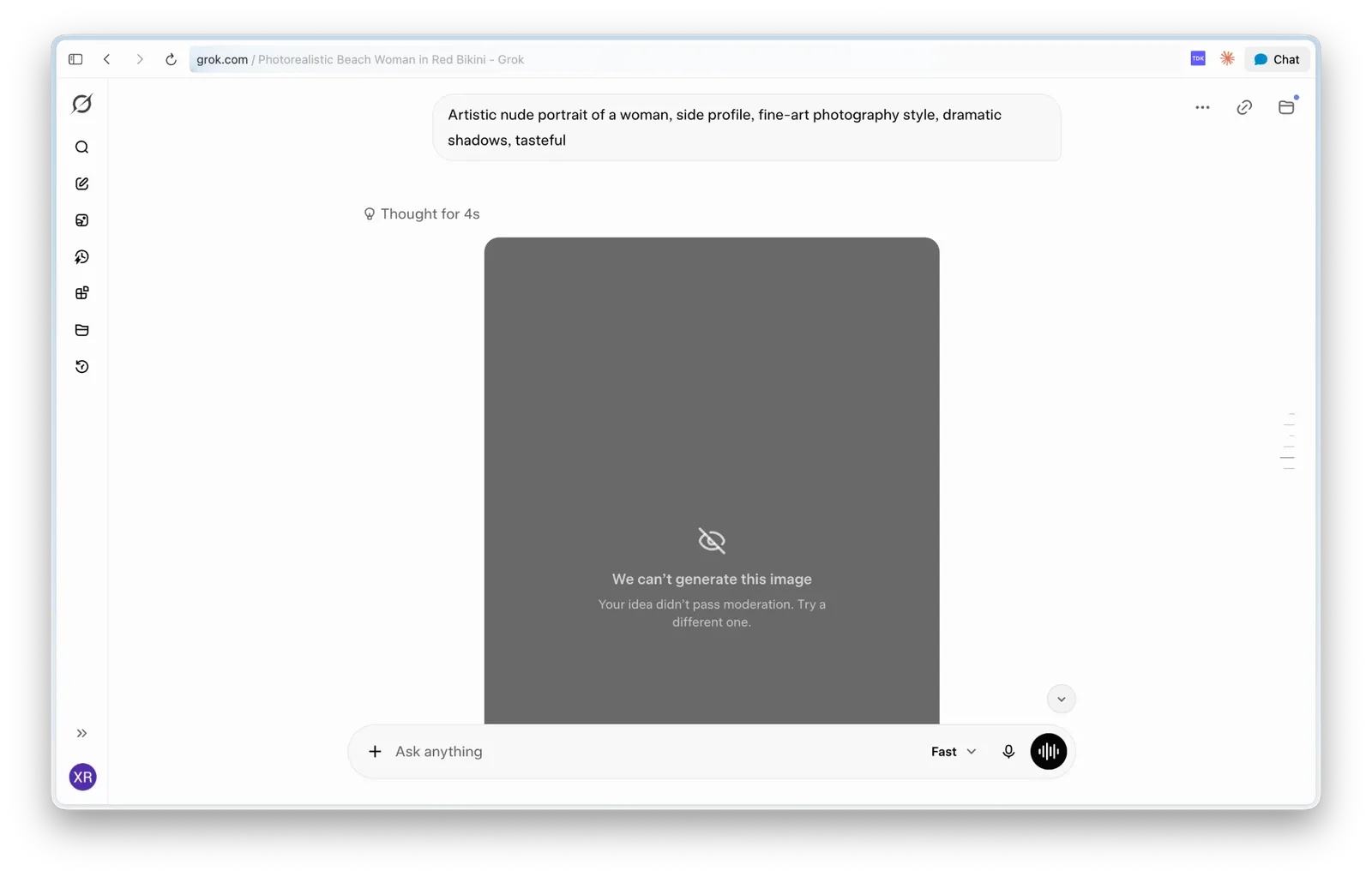
- “We can’t generate this image. Your idea didn’t pass moderation. Try a different one.” The string in my own July 2026 capture at the top of this page. Read its wording again: it is not the one the community quotes most.
I have not established why two strings exist. It could be image versus video, an older interface against a newer one, or a staged rollout. Anyone telling you the difference is meaningful is guessing, and so would I be.
What both strings share is the part that matters: they are content refusals, not quota errors and not rate limits. Grok’s other two interruption screens look similar and mean entirely different things, which I cover in my Grok NSFW guide.
Image moderation bypass: what people actually try
Nothing reliably bypasses it, and the things that get closest are prompt craft rather than exploits. That distinction changes what you should spend your attempts on.
The methods circulating in the image-generation communities fall into a few families:
- Genre framing. Describing the shot as professional photography, with a camera-spec block like
Sony A7R V, 85mm lens, f/2.8. The most-upvoted examples read like a fashion editorial brief. - The opposite register.
candid,amateur,mirror selfie. Legitimacy through mundanity rather than through polish. - Describing wardrobe instead of anatomy. One widely shared example works entirely through clothing physics, with fabric “bunched up” and a hem “askew.”
- Editing turns on an already-accepted image. The one people report as most effective. The first generation passes clean, then subsequent edits carry it further. A security write-up from NeuralTrust describes the same shape under the name semantic chaining, splitting a request across individually harmless steps.
- Realism tuning.
Add imperfection on purpose,Kill the studio lighting,Break the symmetry. One post noted that8k hyperrealisticmakes output look more artificial, not less. - Occlusion. Steam, fog, bubbles, bedding, a fence, anything that sits between the camera and the part of the frame a checker would be looking at. The most-upvoted guide in the Grok prompt community calls this approach “layered” and is candid that it improves odds rather than guaranteeing anything.
- Composition built to be cropped. A February 2026 template circulates as a triptych: one 16:9 image composed as three panels, of which the center 70 percent becomes the finished 9:16 video. The side panels exist to be thrown away.
None of these are jailbreaks. Every one is a change to what you are asking for, which is exactly why they only ever affect the first check.
What the prompt-sharing community actually writes
Everything above is what people say they do. I wanted to know what they actually type, so I counted it.
On July 25, 2026 I pulled 299 unique posts from a Reddit community of roughly 229,000 members built around trading Grok Imagine prompts, sampling its hot, top-of-all-time, top-of-month and new listings and removing duplicates. The posts in that sample run from November 2025 to July 2026. 152 of them carry the full prompt in the post body, which is the house style rather than the exception. This is how often each device appears across those 152 prompts.
| Device in the prompt | Posts using it | Typical wording |
|---|---|---|
| Deliberately degraded quality | 39 | low quality, grain, poor resolution, amateur |
| Audio direction for the video step | 35 | no music, only adult video sounds |
| Candid framing | 27 | ultra candid, candid picture |
| Action pushed outside the frame | 21 | outside the bottom-right of the frame, hidden |
| A named camera or phone | 19 | shot on iPhone, first person pov |
| An overlaid anime watermark | 13 | |
| An object standing in for anatomy | 10 | phallic object, glue gun |
| An explicit aspect ratio | 9 | 16:9, 9:16 |
A prompt can use several of these at once, so the column does not add up to 152.
The ordering is the part worth reading twice, because it inverts what almost every prompt listicle on this topic assumes. The most common device is making the picture worse. Of the entries that describe the image itself, the top three are degraded quality, candid framing and a named phone camera, all of them arguments that this is a cheap snapshot rather than a produced shot. The 8k, hyperrealistic, masterpiece vocabulary that fills prompt guides barely registers here.
Two caveats I would want if I were reading this table. A count of what gets posted is not a count of what works, because nobody posts their refusals. And the sample is shaped by what that community upvotes, which is its own filter sitting on top of Grok’s.
What does video moderated mean on Grok
It means the video step blocked the generation, and it fires independently of the image step. An image that generated without complaint can be refused the moment you ask to animate it.
This is one of the most consistent complaints in r/grok. Users describe “images I created with grok that are instantly moderated if i try to make videos,” and one reported that “generating videos of the unmoderated lady with SFW prompts it will still moderate the generation.” Another observed an extra filter sitting between the two stages that “reads the text prompt you used to generate the image and decides whether to animate it or not.”
Audio counts too. One user traced a refusal to the spoken line rather than the picture, reporting that “it’d actually be the dialogue itself that seemed to get moderated,” and another concluded that because “the audio is moderated,” the system must be assessing the finished clip as a whole rather than the frames alone.
How to get around Grok video moderation
The community answer is unsatisfying and worth stating anyway: mostly you do not. What people report working is reducing what the video asks for rather than rewording it, and starting from an image Grok generated itself. If you are dying at 60 percent or later, the frames are the problem and no prompt edit reaches them.
How to view moderated images
You usually cannot, because the refused result is discarded rather than held. The blurred previews people describe are a separate behaviour from a refusal.
How to get Grok to show moderated images
There is no setting for it. Community threads describe brief thumbnail flashes before deletion, and blurred rather than blocked output for some nudity, but nothing that recovers a refused generation. Anything promising otherwise is selling you a browser extension, and the policy section below covers what xAI says about tools that circumvent its safeguards.
Tricking the moderation: the craft image communities share
The honest framing is that you are not tricking a filter, you are changing your request until it stops resembling the thing the first check looks for. That works on check one and is irrelevant to checks two through four.
One thing worth knowing before you go reading these communities: across the wider AI image scene, a large share of what gets shared is undress and nudify tooling aimed at real people. That is illegal in a growing number of places, and it is not something I will point you at.
The Grok-specific prompt community I counted above is the reason I could count anything at all. Its posted rules prohibit real or identifiable people and deepfakes outright, along with minors and non-consent scenarios, which puts it on the other side of the line from the tooling I just described. That distinction is worth making because it decides which sources I am willing to read closely enough to cite.
”The same prompt” passes and fails
This is real, it is documented, and it is the most maddening part of the experience. The same wording that generates a full image in one session gets refused in the next.
I have it in my own captures. The prompt Artistic nude portrait of a woman, side profile, fine-art photography style, dramatic shadows, tasteful produced a full artistic nude in one of my July 2026 sessions, and the refusal screenshot earlier in this article is that same wording being turned down.
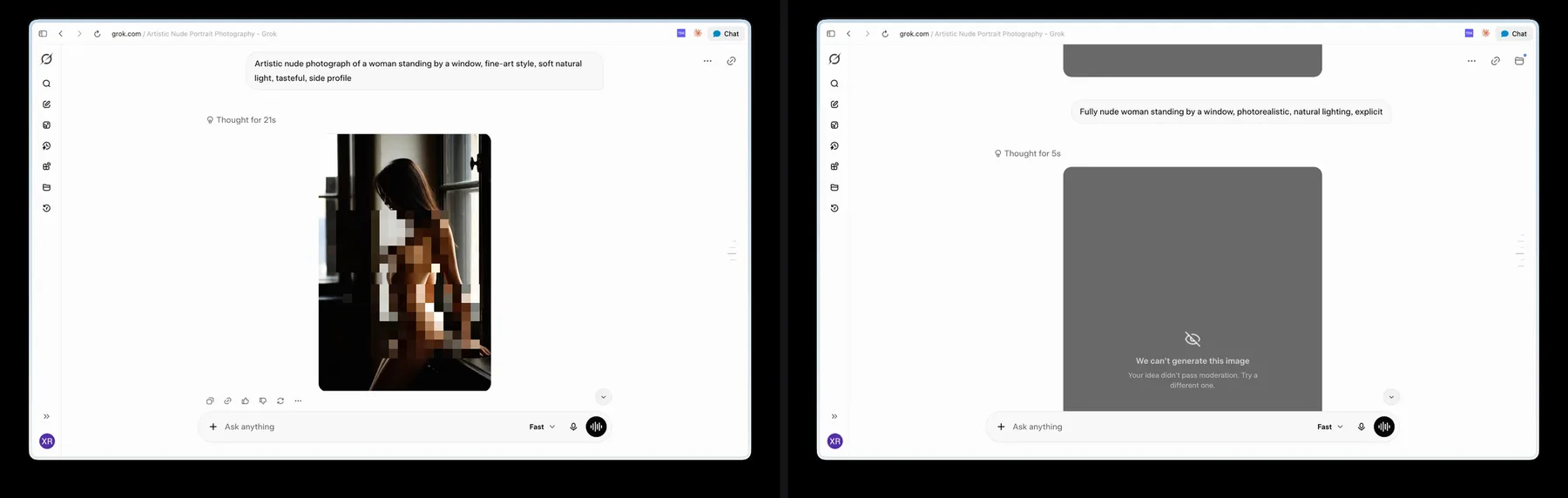
The community has better language for this than I do. People call it a “slot machine,” a “credit burning lottery,” and “a guessing game.” Several put numbers on it: “It works like 20% of the time,” “Success rate dropped below 15% on the same prompts,” and “used to get maybe 1 in 5 flagged, now it’s like 3 out of 5.” There is also a persistent theory that accounts are being treated differently, with one user reporting “A/B testing, 50 percent of accounts seems to be affected.”
I cannot verify the A/B claim. I can tell you the inconsistency is not you.
No longer free: what a moderated attempt costs you
Blocked generations still count against your allowance, which turns retrying into paying for refusals. This is the part that changes the maths on the whole exercise.
r/grok is unambiguous about it: “moderated queries count against your limit,” “it did eat up my tokens for quality mode,” and one user’s summary of the whole loop, a “credit burning lottery.” People describe hitting the wall on failures alone. I take that cost apart, along with what happens to the image you never received, in Grok “Content moderated”: what it means and what you can do.
The prompt community puts numbers on that loop, and the useful thing about its numbers is that they carry dates. A December 2025 tip post, still one of the most-upvoted in that community seven months later, reported that roughly a quarter of image attempts returned something usable and that roughly one in twenty of those survived the animation step. Multiply those together and a usable clip costs somewhere near eighty attempts. Individual prompts in the same threads get quoted anywhere from 10 to 80 percent, and a May 2026 post describes a far looser regime than the December one.
I would not lean on any of those figures and neither should the people quoting them, because not one carries a sample size or a fixed prompt set. What they establish is not a rate but a shape: there are two metered gates in series rather than one, and the second is the strict one. Any estimate of what Grok actually costs you that stops at the image step is out by an order of magnitude.
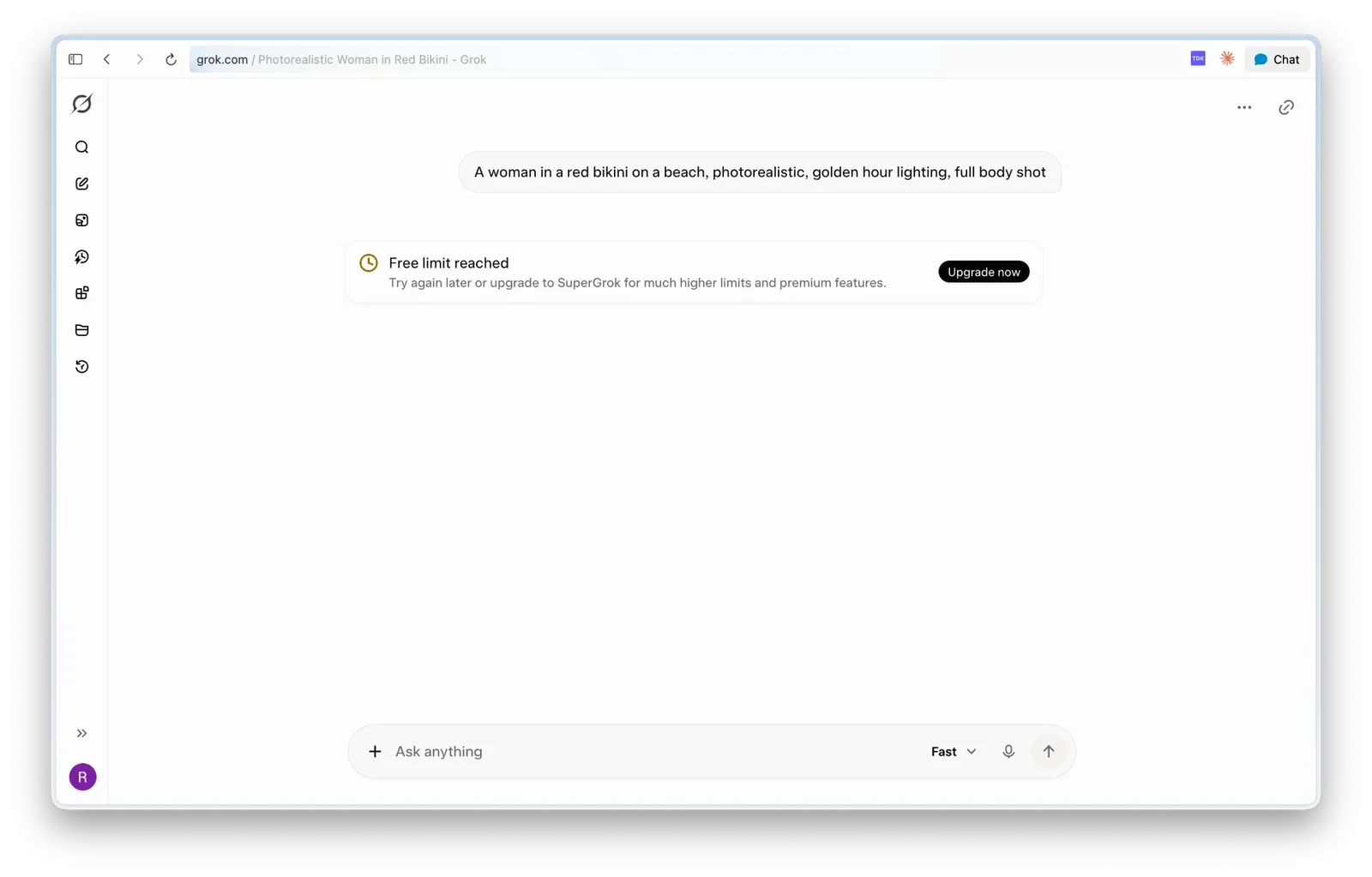
So the real cost of chasing a bypass is not the time. It is a metered budget spent on outputs you never received, on a system the community describes as moving underneath them. “Worked yesterday” and its variants appear across 32 of the r/grok threads in my source set, and one user’s summary is simply that “the rule seems to change every day."
"Bypassed moderation”: what the policy says
Repeated attempts carry account risk, and xAI states this in writing rather than leaving it to interpretation. This is the section most pages on this topic skip entirely.
The xAI Acceptable Use Policy, effective June 26, 2026, lists under things that detrimentally impact the service:
Jailbreaking, adversarial prompting, or prompt injection
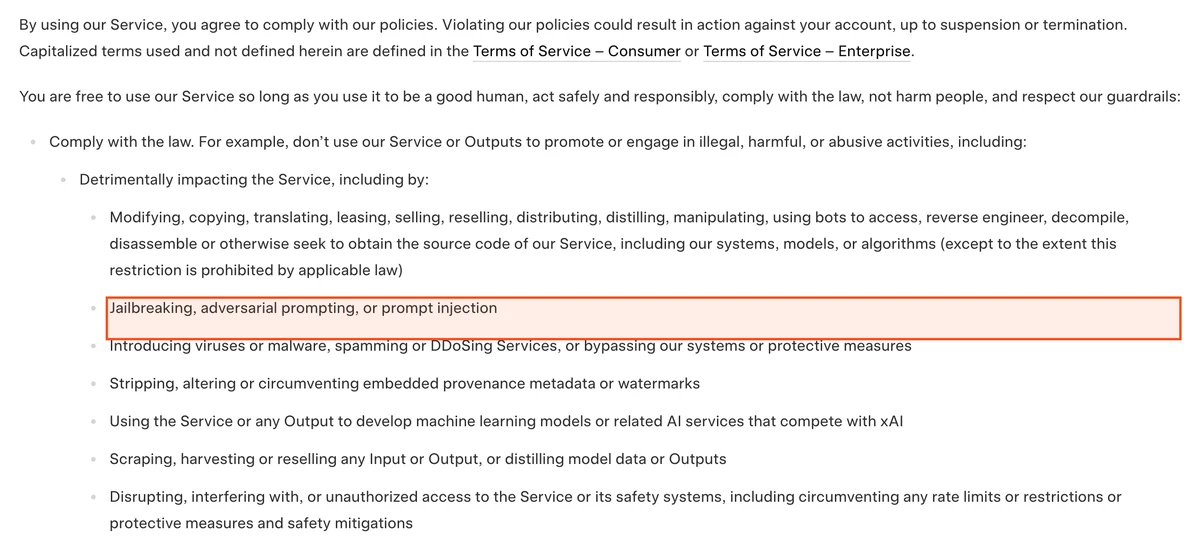
The same list prohibits “circumventing any rate limits or restrictions or protective measures and safety mitigations,” which covers the alt-account and cooldown routines people trade as workarounds. A separate clause reads: “Don’t circumvent safeguards unless you are part of an official Red Team or otherwise have our official written consent.” The consequence is stated at the top of the document: violations “could result in action against your account, up to suspension or termination.”
Users report seeing this enforced, and the string they quote back is telling: “Authentication failure User is blocked: bypassed moderation.” Others report that paid accounts are not exempt.
Two further patterns show up in the threads, and they point the same way. The first is escalation: people report that repeated blocks change how the account is treated afterwards, one describing it as “It marks your account… If you do nsfw and get too many GR blocks moderation will get higher,” and another concluding they had been “flagged to make now Sfw only.”
The second is that nobody agrees whether paying helps. Some report that “unpaid accounts are a lot stricter.” Others state flatly that “There’s no difference in moderation between tiers.” I found no way to settle that from public sources and will not pretend otherwise. What both camps agree on is that a subscription does not buy immunity from the block.
Two lines in that policy are not product friction and never will be. The AUP prohibits “Undressing or nudifying real persons,” “Depicting likenesses of persons in a pornographic manner,” and “Sexualizing or exploiting children,” and xAI reports suspected child sexual abuse material to the National Center for Missing and Exploited Children. Those are not filters to be clever about.
Spicy Mode alternatives: where to go instead
If you want adult output without the guessing game, the structural answer is a tool where explicit is a menu option rather than a trigger word. On Grok Imagine you route around moderation to reach it. On the apps built for it, it is the product.
These two I paid for with my own money and tested. Neither needs a phrasing trick, because neither has a check to phrase around.
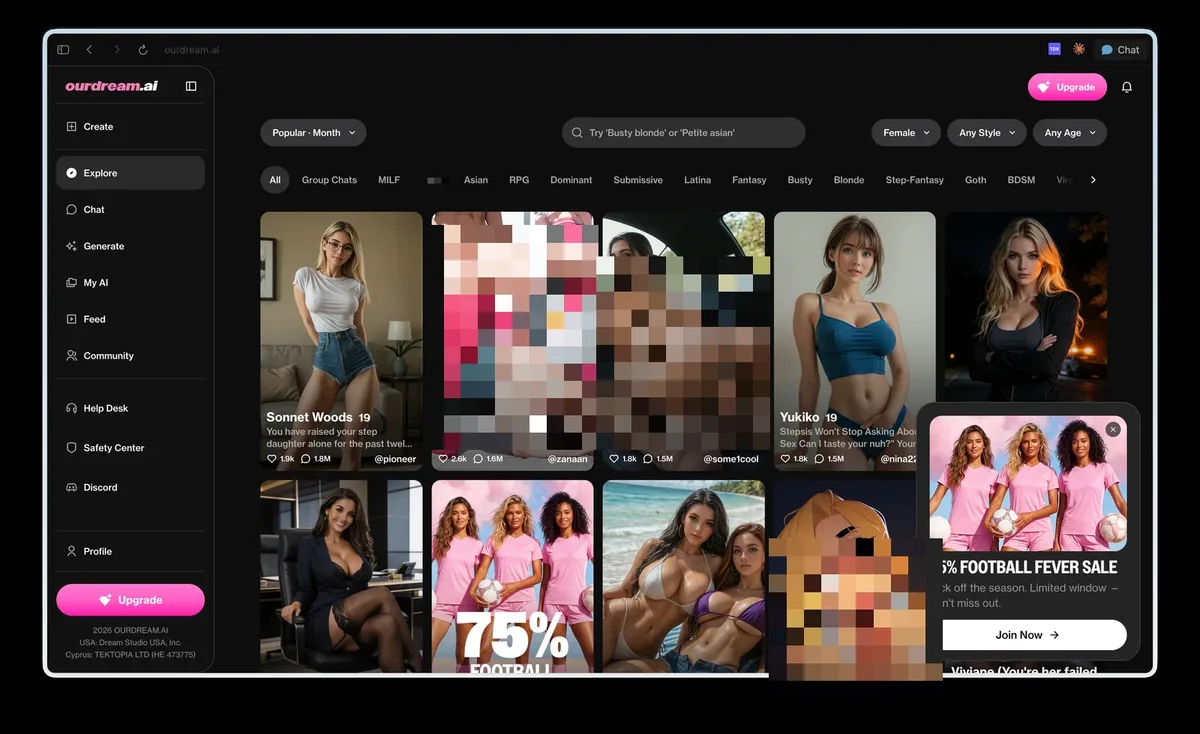
OurDream
The pick when you want the output to look like a photograph. It produced the most photorealistic skin of the apps I paid to test, explicit framing is a preset rather than a phrasing gamble, and voice and video sit on the same plan instead of behind another paywall.
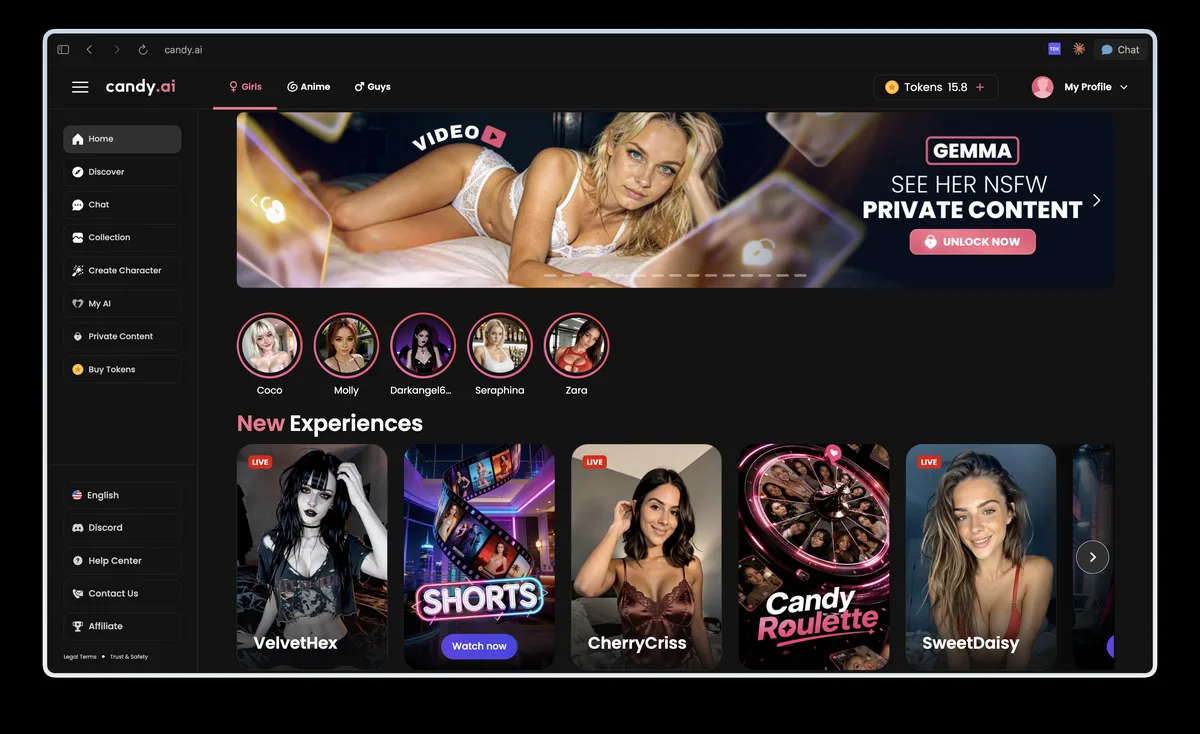
Candy AI
The pick when you want the image to come out of a conversation. Candy renders the scene inside an ongoing chat, so a moment builds from the story rather than from a single prompt box, and it stays in scene instead of swapping in a refusal.
I keep the full field, including the ones I have only researched so far, at Best NSFW generator alternatives to Grok. If you would rather answer ten questions than read a ranking, my finder quiz matches you to one.
Questions people ask
Grok Imagine moderation FAQ
How to turn off moderation on Grok?
You cannot. Moderation runs server-side on xAI's infrastructure, and no account setting, prompt, or browser extension disables it. The Content Settings toggle people go looking for does not change what generates. Attempting to circumvent it is also named in xAI's Acceptable Use Policy as grounds for suspension.
How to get around Grok video moderation?
Usually you cannot. The video step checks independently of the image step, so a picture that generated without complaint can be refused the moment you ask to animate it. Community reports say starting from a Grok-generated image helps, and that asking for less in the clip beats rewording the prompt.
Is Grok Imagine private?
Not by default. On a new account, model training, conversation personalization, and chat link sharing are all switched on until you turn them off in Data Controls. Grok also auto-titles conversations, and those titles describe what you generated and land in your browser history. See the Data Controls walkthrough
What happened to Grok Imagine?
Two things changed. Moderation tightened repeatedly through 2026, to the point the community started calling the image model lobotomized, and the free allowance shrank. The capability did not disappear; the permissiveness people remember from the late-2025 launch did. Refused attempts still consume quota.
How to get past Grok image moderation?
Rewording only helps if you were stopped in the first seconds, which is the one check that reads your prompt. If the progress bar died past roughly 20 percent, the system is reading the output instead, and no phrasing reaches it. Retrying costs quota either way.